pages

Showing posts with label Lights and Leds. Show all posts

How to Build a Shake Tic Tac LED Torch

In the diagram, it looks like the coils sit on the “table” while the magnet has its edge on the table. This is just a diagram to show how the parts are connected. The coils actually sit flat against the slide (against the side of the magnet) as shown in the diagram:

How to Build a Shake Tic Tac LED Torch


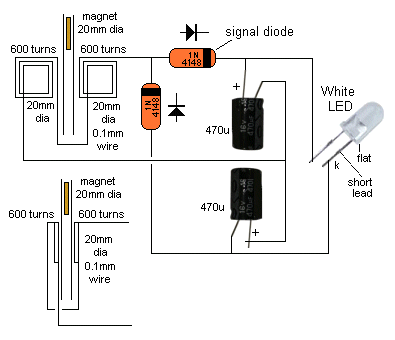
 Shake Tic Tac LED Torch Circuit Diagram

The output voltage depends on how quickly the magnet passes from one end of the slide to the other. That's why a rapid shaking produces a higher voltage. You must get the end of the magnet to fully pass though the coil so the voltage will be a maximum. That’s why the slide extends past the coils at the top and bottom of the diagram.

The circuit consists of two 600-turn coils in series, driving a voltage doubler. Each coil produces a positive and negative pulse, each time the magnet passes from one end of the slide to the other.
The positive pulse charges the top electrolytic via the top diode and the negative pulse charges the lower
electrolytic, via the lower diode.

The voltage across each electrolytic is combined to produce a voltage for the white LED. When the combined voltage is greater than 3.2v, the LED illuminates. The electrostatics help to keep the LED illuminated while the magnet starts to make another pass.

Courtesy Light Extender

In essence, this circuit is a 15 to 20-second courtesy light extender for cars. It is activated in the usual way by opening a door but it also samples the negative lock/unlock signals from a car alarm or central locking and does two more things. First, when an unlock signal is received, it turns on the courtesy light for 15-20 seconds before you open the door. Second, when a lock signal is received, it turns off the courtesy light immediately, with no fade-out. This is done to eliminate false triggering of the burglar alarm through current drain sensing. When a car door is open or the unlock relay is activated, the 33µF capacitor discharges through diode D1 and this keeps transistor Q1 turned off.

Circuit diagram:


 Courtesy Light Extender Circuit Diagram

This allows Q2 and Q3 to turn on and the courtesy lamp is activated. When the door is closed, the courtesy lamps stay illuminated and the 33µF electrolytic capacitor starts charging through the associated 1MO resistor. As the voltages rises, Q1 turns on slowly, turning off Q2 and Q3 which gradually fades out the courtesy lamp. If a lock signal from the central locking system is received, relay 1 closes and charges the capacitor instantly, so the lamp turns off immediately. Relays were used to interface to the central locking/alarm system as a safety feature, to provide isolation in case something goes wrong.
Author: Matt Downey - Copyright: Silicon Chip Electronics

Using LED As A Light Sensor

This circuit shows how to use an ordinary LED as a light sensor. It makes use of the photovoltaic voltage developed across the LED when it is exposed to light. LEDs are cheaper than photodiodes and come with a built-in filter, which is useful when the application involves colour discrimination. The photo-voltage of a red LED (its bandgap voltage) is typically about 2V. The source impedance of this voltage is about 800MΩ in daylight, rising to infinity in darkness. A TL071 JFET input op amp is used to amplify and buffer this extremely high impedance signal.

Circuit diagram:


Using LED As A Light Sensor
LED As A Light Sensor Circuit Diagram
Resistor R1 ensures that the op amp "sees" a 0V input when the LED is in total darkness. To avoid undue loading of the signal, R1 would ideally be a 100MΩ or larger resistor but since such high values are rare and expensive I used a smaller value and increased the gain of the op amp to compensate for the voltage loss. To avoid the need for a second variable resistor to set the op amp’s input offset to zero, R1 must be large enough for the reduced voltage across the LED to swamp the op amp’s input offset voltage. With a 30MΩ resistor for R1, the voltage at the op amp input when the LED is exposed to bright light is reduced to about 60mV.

This is just over four times the 13mV maximum input offset of the TL071 op amp. R1 can be three 10MΩ resistors in series. Alternatively, I have found that a reverse-biased 1N4148 diode has an impedance of about 30MΩ (connect it in the circuit with the anode to ground). The output of the circuit is about 0V when the LED is in darkness. VR1 sets the gain of the op amp and it should be adjusted to give the required output voltage when the LED is exposed to bright light.
Author: Andrew Partridge - Copyright: Silicon Chip

Automatic Low-Power Emergancy Light

Here is a white-LED-based emergency light that offers the following advantages. 1-It is highly bright due to the use of white LEDs. 2-The light turns on automatically when mains supply fails, and turns off when mains power resumes. 3-It has its own battery charger. When the battery is fully charged, charging stops automatically. The charger power supply section is built around 3-terminal adjustable regulator IC LM317 (IC1), while the LED driver section is built around transistor BD140 (Q2).

In the charger power supply section, an input AC main is stepped down by T1 to deliver 9V, 500mA to the bridge rectifier, which comprises diodes D1 through D4. Filter capacitor C1 eliminates ripples. Unregulated DC voltage is fed to input pin 3 of IC1 and provides charging current through D5 and limiting resistor R15. By adjusting preset P1, the output voltage can be adjusted to deliver the required charging current. When the battery gets charged to 6.8V, D6 conducts and charging current from IC1 finds a path throughQT1 to ground and it stops charging of the battery. When mains power is available, the base of Q2 remains high and Q2 does not conduct. Thus LEDs are off.

On the other hand, when mains fails, the base of Q2 becomes low and it conducts. This makes all the LEDs glow. The mains power supply, when available, charges the battery and keeps the LEDs off as Q2 remains cut-off. During mains failure, the charging section stops working and the B1 supply makes the LEDs glow. Assemble the circuit on a general-purpose PCB and enclose in a cabinet with enough space for battery and switches. We have tested the circuit with twelve 10mm white LEDs. You can use more LEDs provided the total current consumption does not exceed 1.5A. Driver transistor Q2 can deliver up to 1.5A with proper heat-sink arrangement.

Circuit diagram:

Automatic Low-Power Emergancy Light
Fully Automatic Emergency Light Circuit Diagram
Parts:

P1 = 2.2K
R1-R12 = 100R-1/2W
R13 = 1K-1/2W
R14 = 180R-1/2W
R15 = 16R/5W
R16 = 1.2K
C1 = 1000uF-25V
D1-D5 = 1N4007
D6 = 6.8V-0.5W Zener
D7-D18 = 10mm- White LEDs
Q1 = BC548
Q2 = BD140
B1 = 6V-4.5Ah Battery
IC1 = LM317
T1 = 9Vac-Transformer